
Annihilation Terror

I was not born into absence. I was born into anticipation.
My parents conceived me believing my older sister might die. Her disability had already reorganized the family around fear, vigilance, and grief for a future that would not arrive. I entered a system that was braced for catastrophe—and then never stood down from it.
My sister lived. She did not die. But she also did not recover in the way my parents had hoped. The emergency never resolved. It simply became permanent.
This distinction matters. I was not a replacement child in the literal sense. No one died and was swapped out for me. But my existence was still tethered to loss—anticipated loss, ambiguous loss, chronic overwhelm. I arrived as continuity in the face of possible annihilation. And that shaped how my nervous system learned what it meant to exist.
I grew up protected. I was fed, clothed, sent to school, and kept physically safe. I was not parentified. My mother did not turn me into a caretaker. She tried, often heroically, to let me be a child.
But protection is not the same as emotional capacity. And capacity was already exhausted.
There was an unspoken hierarchy of suffering in our home. My sister’s needs were real, visible, and urgent. My mother’s pain and resentment took up space in our home, a lot of space. She suffered because of my sister, the child that she told the doctors not to save when she was born so ill. Now she was stuck and bitter
Her only joy seemed attached to my older brother the golden child.
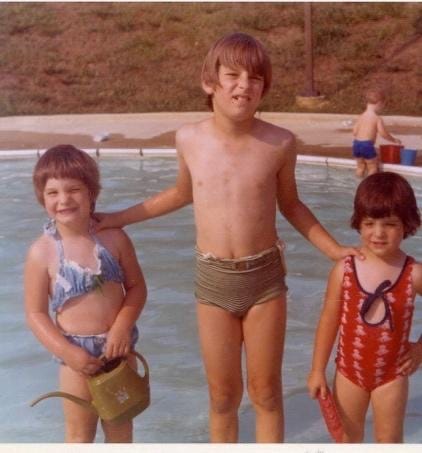
My suffering was not allowed, I screamed and cried and eventually passed out, as my mother stood by telling the horrified newspaper boy at the door that “she just wants attention”. This was a story told repeatedly through the years, as a “funny” story.
I learned early that wanting too much time, attention, ease risked destabilizing a system that was already stretched thin.
Sometimes I would say, as children do, that I wished my sister were not disabled. I did not mean I wished her gone. I meant I wished our lives were easier. I meant I wished for spaciousness.
My mother would respond, sharply and definitively: “You are lucky. If she hadn’t been disabled, you would never have been born.”
It turns out, that sentence lodged in my body.
It told me my existence was conditional. That my wishes were dangerous. That my life was justified only by tragedy. That to question the shape of our family was to question my right to exist.
This was existential.
My family carries Holocaust lineage. My maternal great grandmother escaped Hungary before the war. Most of her family did not survive. Loss, for us, was not theoretical. It was historical, total, and unredeemed. Survival carried moral weight. Gratitude was not a feeling; it was a duty.
In families shaped by genocide, existence is never neutral. Someone lived while others did not. Someone was spared. Someone took up space that others lost forever.
That moral framework filtered down through generations. It shaped how suffering was interpreted, how joy was rationed, how need was assessed. And in that context, a child conceived during anticipated loss learns something very specific:
Do not add burden. Do not want too much. Do not take up space unless you must.
Attachment theory has language for this. Though I struggle ton name it exactly.
I was cared for but not fully received.
Donald Winnicott wrote that the deepest fears are not of future catastrophe; a child does not fear that something terrible will happen. The child fears that something terrible already did, and that memory is stored in her body. And that it could happen again if they are too much.
I learned to exist carefully.
I learned to be the child who coped, who understood, who did not ask for what the system could not give. I learned to minimize my own distress and to feel guilt when I felt joy. I learned that my needs were negotiable.
I never knew I was allowed to be angry. Ever.
So I was sad, not understanding why. I was anxious, scared to go to sleep.
Because all of it left me with what clinicians call annihilation anxiety, not fear of death, but fear of erasure. Fear of disappearing if I took up too much emotional room.
This fear showed up in the Operating Room right before the many surgeries last year, compounding the medical trauma, or perhaps causing it. I feared that I would disappear in a room filled with tired strangers, with no friends or families in the waiting room.
I learned recently that my bipolar illness emerged fully in my body, this attachment logic collided with biology. My nervous system required accommodation, sleep protection, medication, ongoing care. But the old rule still whispered: don’t need too much.
I tried to heal my way out of needing. I tried insight, effort, trauma work, self-discipline. I believed that if I did the work deeply enough, I would earn the right to be well.
It wasn’t until trauma therapy loosened the grip of shame that I could finally accept something kinder and truer: this is a serious, biologically based illness. It is not my fault. And I do not have to justify needing care.
Naming the severity of my illness did not collapse me. It relieved me.
Because severity moved responsibility out of morality and into reality. It allowed me to stop asking my nervous system to do the impossible. It allowed me to exist without apology.
I am not a replacement child. I am not a mistake. I am not lucky only because someone else suffered.
I was born into a family that never recovered from crisis. I learned to survive inside that reality. And now, I am allowed to update the rules.
.
First off - great piece! The idea of joy being rationed really hit me. It reminds me of how many of us grew up with this idea that before you experience joy, happiness, relaxation - you must earn it. Joy being rationed feels similar to this mindset and it strikes a chord with me. I believe cognitively that joy is limitless, abundant, and available to all creatures - never something that can be capped. And that if it has its own 'energy' then I would imagine it would want to be expanded, shared, and become part of everything. But there is always an opposite in everything. The feeling or 'energy' of total erasure or annihilation is more frightening than death itself (in my opinion).
I had a dream when I was 14 - and in the dream I was being chased by these mannequin -like men. They were tall, slender, dark gray with no faces - and terrifying. Intuitively, telepathically, I knew they wanted to annihilate and erase me, my soul, my existence completely! I was faced with the decision to jump off a very steep cliff resulting in certain 'death' as they came closer and closer - so I jumped. The dream is very long and needless to say - it had a great ending and even until today remains the most vivid memory, experience I've ever had. I remember every detail and every feeling from that dream.
I believe that we are not born into absence nor do our spirits, souls, energy come from or return to absence. This existential wrestling we all experience on this mortal journey may be a result of forgetting who we really are - and the wrestling is our human way to 're-member' our true selves with the 'Divine'. I find that I can 're-member' myself, my true self - the more time I spend in nature, especially the ocean, and with animals. There is a felt sense of being included, connected, and wanted - a glimpse of what a secure attachment actually feels like.
Hello Dear Tracey, this is so poignant. It is bringing up all the memories of us in childhood. You always seemed so energetic and were so good at sports. I loved that about you. And I remember feeling that you were loving towards Liza. I'm glad you're on the path to self love.